Showing posts with label Soviet Union. Show all posts

Monday, June 22, 2009

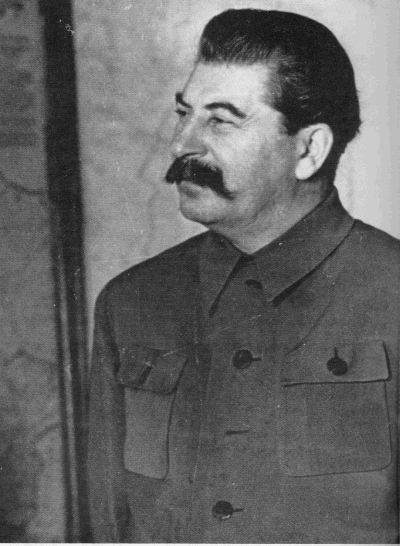
Joseph Stalin: A Life


(Taken from the link: http://www.marxists.org/glossary/people/s/t.htm#stalin-josef)


Stalin, Joseph (1879-1953)

Stalin, a political name adopted when he was 34, meaning Man of Steel, studied for the priesthood under his real name, Dzhugashvili. Son of a shoe maker, he joined the Social Democratic party after being expelled from a theological school for insubordination. After the RSDLP split in 1903, Stalin became a member of the Bolshevik party.

In Stalin's early years he was continually in trouble with the local authorities. During this period he took the nickname Koba, after the famous Georgian outlaw and the name of a character in the romance "Nunu", by the Georgian author Kazbek. The celebrated brigand Koba was known as a fighter for the the rights of the people, while the fictional Koba was depicted as sacrificing everything in his struggle against the Tsarist authorities on behalf of his people, but unsuccesful, freedom was lost.

Koba escaped prison exile several times, at his last escape he fled to St. Petersburg, where he became a member of the editorial staff of Pravda in 1912. Within a year, Stalin was arrested again and exiled to Siberia. He was released from exile by general amnesty after the February Revolution of 1917, and went back to the editorial staff of Pravda in Petrograd.

After the October Revolution Stalin was elected to the post of commissar for nationalities.
Throughout the following civil war, Stalin ascended the ranks of the government through extensive bureaucratic manoeuvering and in 1922, received the majority vote to become the General Secretary of the Communist party. In the same year Lenin called for his removal, explaining that Stalin had amassed to much power, in what was to become known as Lenin's last testament.

Following Lenin's death in 1924, a wave of reaction swept through the Soviet government. Stalin introduced his theory of socialism in one country, where he explained that Socialism could be achieved by a single country.

Unlike former inner-party debates, where the positions of either side were written in newspapers, talked about in public meetings and soviets; the reaction and practices of the long and devastating civil war, caused a 'debate' that was completely hidden from the public, in order to 'establish the appearance' of a healthy, stable, government.

In 1927, after years of bureaucratic manoeuvering, the members in the government that were part of the Left Opposition were deported on a wide scale. Immediately following, Stalin announced his theory of social fascism, describing that the theories of Social-Democracy and Fascism were essentially the same. Following this new theory, members of Social-Democratic organisations (of which Bolsheviks were once a part) were arrested or deported. In 1929 the right-wing of the Communist party, led by Bukharin, was removed from the so-called "soviet" government by the Stalinists.

In late 1928, Stalin introduced methods of productively advancing the Soviet Union via forced industrialisation and collectivisation. These efforts were tasked out in five year plans, the first of which included a widescale campaign of mass executions, arrests, and deportations of the kulak class.

Russia advanced tremendously from the draconian measures implemented to ensure that "socialism in one country" could survive. Russia moved from complete devastation and destruction after WWI and the Civil War, to become a nation that was one of the most powerful in the world: achieving such goals that 30 years previous would have been viewed as wholly impossible.

From 1934 to 1939 Stalin ordered a series of executions and imprisonments, largely directed towards people within the Soviet government. Half of the members of the first Council of Peoples Commissars were executed in 1938 (A quarter of them had died natural deaths before hand, of the remaining quarter only Stalin lived past 1942). Some government officials executed were thought to be Nazi agents or sympathisers, while others were accused for planning to overthrow the Soviet government. Members of the Left Opposition who were allowed to return to the party after accepting Stalinism were soon executed, those who remained abroad were hunted down and killed. Also executed were people belonging to the right-wing of the party (Bukharin and others). The exact number of people executed is not known, estimates range from thousands to millions.

During WWII Stalin organised and lead the Soviet Union to victory over the invading Nazi armies. [...]


Friday, June 19, 2009

A History of Trotskyism


Trotskyism

Trotskyism is a Marxist theory whose adherents aim to be in the vanguard of the working class, particularly as opposed to Stalinism and Social Democracy. When opposed to Stalinism, Trotskyists place emphasis in their objective of eliminating Stalinist bureaucratic rule; in opposition to Social Democracy, Trotskyists advance the cause of militant workers revolution.
Trotskyist theory in the 20th century had three unique components, which set it apart from other Marxist currents:

Permanent Revolution: This theory stipulates that colonial/feudalist nations must engage in socialist revolutions, as opposed to the stagist theory of first having a capitalist revolution.


Political Revolution: The idea that the Soviet Union could be restored to a worker's democracy with a political revolution (as opposed to a social and economic revolution, in the traditional Marxist sense of the word.)


Transitional Programme: The use of "Transitional Demands" which can be introduced into workers' struggles with the possibility of receiving widespread support even in non-revolutionary times, but which lead into conflict with capitalism (forming a United Front, for example). Such demands are deemed to form a "bridge" between the "Maximum program" of revolution and the "Minimum program" of minor reforms under capitalism. (See the The Transitional Program).

In the 21st century, the theory of political revolution is no longer relevant, while the subject of permanent revolution has witnessed historical changes while retaining its relevance. The transitional programme remains valid for many Trotskyists, though to varying degrees.
Historical Development: Named after Leon Trotsky, the leader of the Left Opposition within the Communist Party of the Soviet Union, Trotskyism is the current of Marxism which originated in the International Left Opposition - those members of the Communist International who solidarised with Trotsky's positions in the late 1920s as opposed to Stalin's politics. After the victory of Hitler in Germany in the early 1930s (See Trotsky's writings on the subject), the Trotskyists went on to found a new, Fourth International in opposition to the Third (Communist) International. Though the Trotskyists remained very isolated for many years, in the 1960s many Trotskyist groups were able to build viable organisations at a time when Communist parties were in decline.

The Communist International was always an instrument of foreign policy of the Soviet Union, but in the earliest days this meant the building of communist parties whose aim was to emulate the Bolsheviks and make socialist revolution in their own country. Later, the Comintern became an instrument for bargaining and diplomacy rather than the fostering of revolution. The leaderships of national Communist parties were bureaucratically replaced by orders from Moscow and the serious disputes taking place within the Soviet party misrepresented to the young parties of the Comintern.

The first Trotskyists were people like James Cannon who had visited the Soviet Union as loyal delegates of their Communist Party, but then, having witnessed the struggle taking place within the Soviet party, returned to their home country and set up International Left Opposition groupings.

The issues at this time concerned the reasons for the failure of the German Revolution in 1923, the conduct of the target="_top"1926 General Strike in Britain, and whether the situation in Europe was ripe for revolution, and the tactics of the Chinese Revolution in 1926 and relations between the communists and nationalists.

Until the mid-1930s, these international supporters of Trotsky continued to argue within the Communist Parties of the different countries, even though they were all expelled from membership, vilified and often physically attacked if not murdered. The aim of the Trotskyists until the mid-1930s was to change the leadership and policies of the Soviet Union and the Communist International, and return it to a Marxist orientation, rather than to set up a rival organisation.

The failure of the Comintern to bring about a United Front between Communists and Social Democrats in Germany in the 1930s, opening the door to Hitler, was a turning point. Trotsky remarked, however, that it was not so much that this grave error had been made, but rather that within the ranks of both the leadership and the rank-and-file of the Communist International there was neither recognition of this mistake, nor any attempt to correct it. This, according to Trotsky, meant that the Comintern was "dead for the purposes of Revolution".
Accordingly, the Fourth International was founded in 1938. The aim of the Fourth International was to defend the Soviet Union as a workers' state, independent of the capitalist powers with nationalised means of production controlled by the working class, while at the same time, struggling to overthrow the Stalinist government of the Soviet Union.

The Fourth International suffered badly during World War Two. Not only was its leader, Leon Trotsky, assassinated by a Stalinist agent in August 1940, but many of its members were either murdered, died fighting fascism, or were betrayed to the Nazis by their Communist Party rivals.
After the War, the Red Army soon found itself in control of half of Europe. Despite Stalin's aim to restore capitalist governments in Eastern Europe as a buffer between the Soviet Union and the West, capitalism was soon overthrown in these countries and pro-Soviet, already-bureaucratised, "communist" governments installed.

This posed problems for the small remaining forces of Trotskyism. They had predicted that the War would be followed by revolutions, but they had not expected that the Red Army would be leading them. These new states were characterised as "deformed workers states" by analogy with the Soviet Union which they described as a "degenerated workers state."

The Fourth International grew only slowly for two decades after the War, while at the same time it had split into several competing factions. However, the Hungarian Uprising in 1956 and the subsequent Soviet invasion of Hungary, created an opening in which a number of leading Communist Party intelligentsia in countries around the world switched to Trotskyism. Later, when the Red Army invaded Czechoslovakia to put down the "Prague Spring" the Trotskyists made more gains. The events of 1968 in fact triggered widespread, new social movements and working class struggles, and the Trotskyist parties were well placed to intervene in these events, and grew in strength.

Surprisingly perhaps, the crisis in the Communist Parties in the late-1980s and early 1990s, which culminated in the collapse of the Soviet Union itself, and accompanied by the dissolution of many Communist Parties around the world, also affected the Trotskyist parties. However, many have survived this change of terrain, and Trotskyist parties are to be found all over the world today, and in some countries are larger and more active than those remaining of the former parties of the Comintern.