Showing posts with label Bolshevik. Show all posts

Monday, June 22, 2009

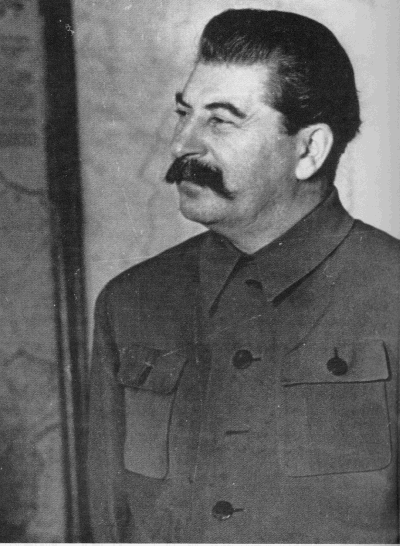
Joseph Stalin: A Life


(Taken from the link: http://www.marxists.org/glossary/people/s/t.htm#stalin-josef)


Stalin, Joseph (1879-1953)

Stalin, a political name adopted when he was 34, meaning Man of Steel, studied for the priesthood under his real name, Dzhugashvili. Son of a shoe maker, he joined the Social Democratic party after being expelled from a theological school for insubordination. After the RSDLP split in 1903, Stalin became a member of the Bolshevik party.

In Stalin's early years he was continually in trouble with the local authorities. During this period he took the nickname Koba, after the famous Georgian outlaw and the name of a character in the romance "Nunu", by the Georgian author Kazbek. The celebrated brigand Koba was known as a fighter for the the rights of the people, while the fictional Koba was depicted as sacrificing everything in his struggle against the Tsarist authorities on behalf of his people, but unsuccesful, freedom was lost.

Koba escaped prison exile several times, at his last escape he fled to St. Petersburg, where he became a member of the editorial staff of Pravda in 1912. Within a year, Stalin was arrested again and exiled to Siberia. He was released from exile by general amnesty after the February Revolution of 1917, and went back to the editorial staff of Pravda in Petrograd.

After the October Revolution Stalin was elected to the post of commissar for nationalities.
Throughout the following civil war, Stalin ascended the ranks of the government through extensive bureaucratic manoeuvering and in 1922, received the majority vote to become the General Secretary of the Communist party. In the same year Lenin called for his removal, explaining that Stalin had amassed to much power, in what was to become known as Lenin's last testament.

Following Lenin's death in 1924, a wave of reaction swept through the Soviet government. Stalin introduced his theory of socialism in one country, where he explained that Socialism could be achieved by a single country.

Unlike former inner-party debates, where the positions of either side were written in newspapers, talked about in public meetings and soviets; the reaction and practices of the long and devastating civil war, caused a 'debate' that was completely hidden from the public, in order to 'establish the appearance' of a healthy, stable, government.

In 1927, after years of bureaucratic manoeuvering, the members in the government that were part of the Left Opposition were deported on a wide scale. Immediately following, Stalin announced his theory of social fascism, describing that the theories of Social-Democracy and Fascism were essentially the same. Following this new theory, members of Social-Democratic organisations (of which Bolsheviks were once a part) were arrested or deported. In 1929 the right-wing of the Communist party, led by Bukharin, was removed from the so-called "soviet" government by the Stalinists.

In late 1928, Stalin introduced methods of productively advancing the Soviet Union via forced industrialisation and collectivisation. These efforts were tasked out in five year plans, the first of which included a widescale campaign of mass executions, arrests, and deportations of the kulak class.

Russia advanced tremendously from the draconian measures implemented to ensure that "socialism in one country" could survive. Russia moved from complete devastation and destruction after WWI and the Civil War, to become a nation that was one of the most powerful in the world: achieving such goals that 30 years previous would have been viewed as wholly impossible.

From 1934 to 1939 Stalin ordered a series of executions and imprisonments, largely directed towards people within the Soviet government. Half of the members of the first Council of Peoples Commissars were executed in 1938 (A quarter of them had died natural deaths before hand, of the remaining quarter only Stalin lived past 1942). Some government officials executed were thought to be Nazi agents or sympathisers, while others were accused for planning to overthrow the Soviet government. Members of the Left Opposition who were allowed to return to the party after accepting Stalinism were soon executed, those who remained abroad were hunted down and killed. Also executed were people belonging to the right-wing of the party (Bukharin and others). The exact number of people executed is not known, estimates range from thousands to millions.

During WWII Stalin organised and lead the Soviet Union to victory over the invading Nazi armies. [...]


Friday, June 19, 2009

Leon Trotsky: A Life


Trotsky, Leon (1879-1940)

Became a revolutionary in 1896. Later worked with Lenin on Iskra in 1902. He broke with Lenin the next year over the nature of the revolutionary party and aligned himself with the Menshevik faction of the Russian Social Democratic Labor Party. He broke with the Mensheviks in 1904 and tried during the next decade to reunite the factions of the RSDLP. In the 1905 revolution, he was the leader of the St. Petersburg Soviet and developed the theory of Permanent Revolution. In 1915 he wrote the Zimmerwald manifesto against the war.

Trotsky joined the Bolshevik Party in 1917 and was elected to its central committee. Shortly following Trotsky helped organize the October Revolution.

Trotsky's first government post in the R.S.F.S.R. was as commissar of foreign affairs. In 1918 he became commissar of war, organizing the Red Army and leading it to victory through the civil war and imperialist intervention.

In 1923 Trotsky formed the Left Opposition and for the ensuing decade battled the reactionary wave of Stalinism sweeping through the Soviet Union. The opposition was unsuccessful, and Trotsky was expelled from the Communist Party and the Comintern, and exiled to Turkey in 1927. In 1933 he gave up his efforts to reform the Comintern and called for the creation of a new International. He viewed his work on behalf of the Fourth International as the most important of his life. See the Leon Trotsky Internet Archive

Vladimir Lenin: A Life


(Taken from the link: http://www.marxists.org/glossary/people/l/e.htm#lenin)

Lenin, Vladimir Ilyich (1870-1924)

One of the leaders of the Bolshevik party since its formation in 1903. Led the Soviets to power in October, 1917. Elected to the head of the Soviet government until 1922, when he retired due to ill health.
Lenin, born in 1870, was committed to revolutionary struggle from an early age - his elder brother was hanged for the attempted assassination of Czar Alexander III. In 1891 Lenin passed his Law exam with high honors, whereupon he took to representing the poorest peasantry in Samara. After moving to St. Petersburg in 1893, Lenin's experience with the oppression of the peasantry in Russia, coupled with the revolutionary teachings of G V Plekhanov, guided Lenin to meet with revolutionary groups. In April 1895, his comrades helped send Lenin abroad to get up to speed with the revolutionary movement in Europe, and in particular, to meet the Emancipation of Labour Group, of which Plekhanov head. After five months abroad, traveling from Switzerland to France to Germany, working at libraries and newspapers to make his way, Lenin returned to Russia, carrying a brief case with a false bottom, full of Marxist literature.
On returning to Russia, Lenin and Martov created the League for the Struggle for the Emancipation of the Working Class, uniting the Marxist circles in Petrograd at the time. The group supported strikes and union activity, distributed Marxist literature, and taught in workers education groups. In St. Petersburg Lenin begins a relationship with Nadezhda Krupskaya. In the night of December 8, 1895, Lenin and the members of the party are arrested; Lenin sentenced to 15 months in prison. By 1897, when the prison sentence expired, the autocracy appended an additional three year sentence, due to Lenin's continual writing and organising while in prison. Lenin is exiled to the village of Shushenskoye, in Siberia, where he becomes a leading member of the peasant community. Krupskaya is soon also sent into exile for revolutionary activities, and together they work on party organising, the monumental work: The Development of Capitalism in Russia, and the translating of Sidney and Beatrice Webb's Industrial Democracy.
After his term of exile ends, Lenin emigrates to Münich, and is soon joined by Krupskaya. Lenin creates Iskra, in efforts to bring together the Russian Social Democratic Labour Party, which had been scattered after the police persecution of the first congress of the party in 1898.
[...]
After leading the October Revolution, Lenin served as the first and only chairman of the R.S.F.S.R.. In 1919 Lenin founded the Communist International. In 1921 Lenin instituted the NEP. During 1922 Lenin suffered a series of strokes that prevented active work in government. While in his final year – late 1922 to 1923 – Lenin wrote his last articles where he outlined a programme to fight against the bureaucratization of the Commmunist Party and the Soviet state. Lenin died on January 21, 1924.


You can find further reading on the life of Vladimir Lenin at the Lenin Biographical Archive at:

http://www.marxists.org/archive/lenin/bio/index.htm